Liquid follows the moving wire
Viscous drag pulls liquid upward with the wire. At otherwise similar conditions, faster withdrawal and higher effective viscosity commonly increase the amount of liquid entrained.
Often called meniscus coating or withdrawal coating, this process deposits liquid on a moving wire as it is withdrawn from a bath, without a metering die orifice controlling the film.
As the wire moves out of the bath, viscous drag carries liquid with it. The liquid-air interface remains free to change shape; a solid die orifice does not pin or constrain that interface.
The process deposits a wet film. Solids content, evaporation, drying and curing can change the thickness of the finished coating after the wire leaves the bath.
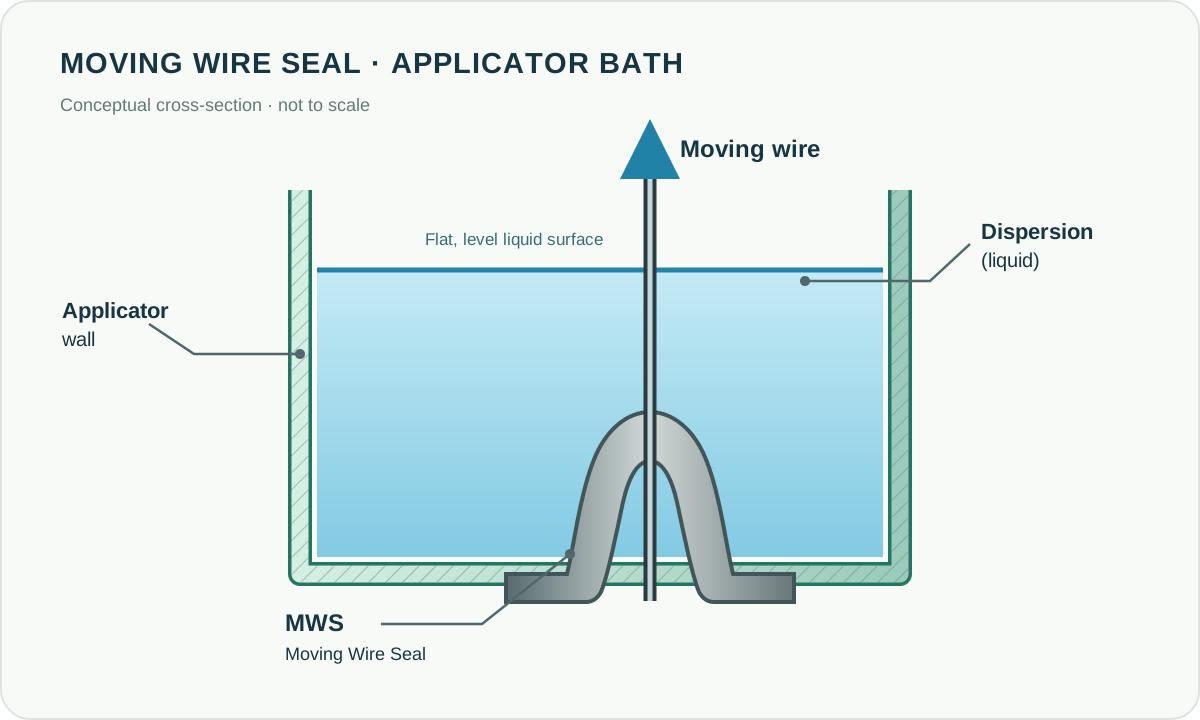
The deposited film reflects the coupled behavior of the moving fluid, the free surface and gravity.
Viscous drag pulls liquid upward with the wire. At otherwise similar conditions, faster withdrawal and higher effective viscosity commonly increase the amount of liquid entrained.
Surface tension holds the liquid-air interface together and shapes the meniscus. At otherwise comparable conditions, greater surface tension often resists viscous entrainment and tends toward a thinner wet film; actual response also depends on wetting and the other operating conditions.
Gravity pulls excess liquid toward the bath after withdrawal. Drainage becomes more influential at low line speeds and when the wet film is relatively thick.
These relationships describe general tendencies. The actual response should be established for the specific fluid, wire and applicator.
| Variable | Practical influence |
|---|---|
| Line speed, U | The primary real-time control variable. Speed variation can produce lengthwise thickness variation; higher withdrawal speed commonly increases viscous entrainment. |
| Wire radius, R | Wire curvature affects capillary pressure. Smaller wires are more sensitive to curvature and wetting effects. |
| Dynamic viscosity, μ | Higher effective viscosity generally increases entrainment at a given speed. For shear-thinning fluids such as polymer dispersions or enamels, account for viscosity at the shear rates near the wire. |
| Surface tension, γ | Shapes and stabilizes the free meniscus. The resulting film thickness also depends on wetting, wire surface condition, speed and viscosity. |
| Fluid density, ρ | Contributes to gravity-driven drainage of the wet film, especially at low line speeds or with thicker films. |
| Withdrawal angle | A vertical, aligned wire lets gravity drain along the wire path with circumferential symmetry. Tilt can promote one-sided drainage and coating eccentricity. |
Free-Meniscus PTFE Wire-Coating Simulator. Explore how wire diameter, line speed, PTFE solids, viscosity, surface tension, and pass count affect the model's estimated coating build.
Keep the wire path and withdrawal conditions steady through the applicator.
Capstan or take-up speed ripple changes viscous entrainment and can create thickness banding along the wire.
Lateral vibration disturbs the dynamic meniscus and can create uneven coating or surface waves.
Use enough tension to limit wire wander while keeping stress below the level that causes permanent stretch or a lasting diameter change.
A tilted path can make gravity drain the wet film unevenly around the wire before the coating dries or cures.
These examples involve coating moving wire or fiber. The exact production method varies; a line may use a free meniscus, a die, a pressurized applicator or a combination.
Insulating coatings are applied in continuous wire processes. Depending on the line, coating may be controlled by a die or another applicator.
Fiber coating systems manage a moving cylindrical substrate and free-surface behavior, often within specialized applicators.
Polymer and functional coatings are applied to guidewire substrates using process-specific bath, die or other coating methods.
The Moving Wire Seal is an elastomer seal at the applicator entry. It is not a metering die and does not set film thickness. The free meniscus and the line conditions govern wet-film formation.
These studies examine withdrawal coating, cylindrical substrates and the influence of fluid and operating conditions.
The cited studies describe particular fluids and process conditions; they are background references, not a performance guarantee for any MWS installation.