Clean and dry only if needed
If the PTFE-coated wire is supplied clean and dry and is protected from contamination, cleaning and drying may be omitted. If needed, fully dry the wire before etching.
Moving Wire Seals are designed for continuous wire processes where a moving wire passes through an applicator bath or treatment tube. This page explains PTFE surface etching as one example application, with MWS units sealing the wire path at the FluoroEtch® tube inlet and outlet. FluoroEtch® is chemically aggressive toward most standard elastomers and seals. Because it combines a strong reducing agent (sodium naphthalide) with a polar glycol ether solvent (diglyme), it attacks rubber through both chemical stripping and severe solvent swelling.
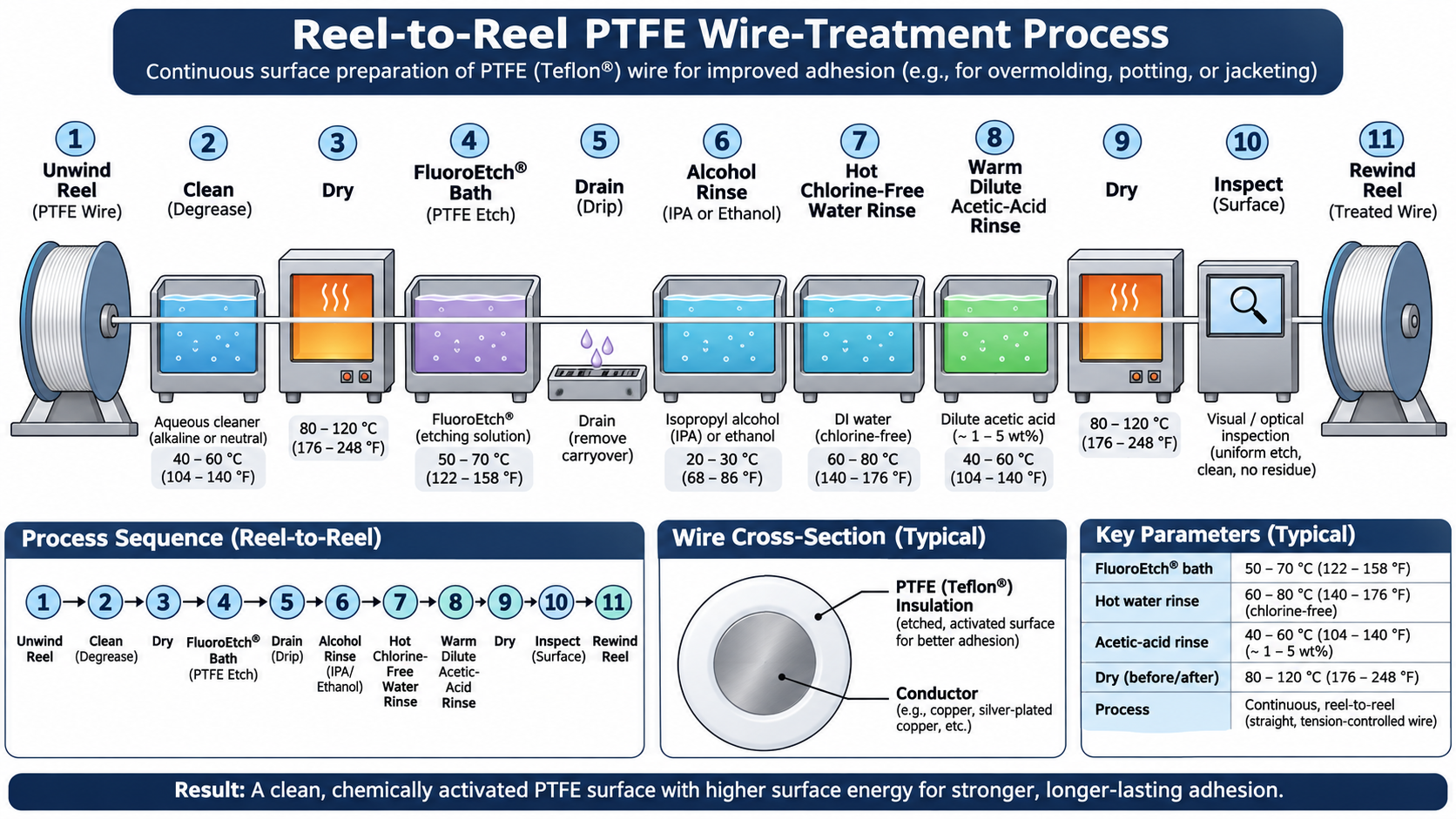
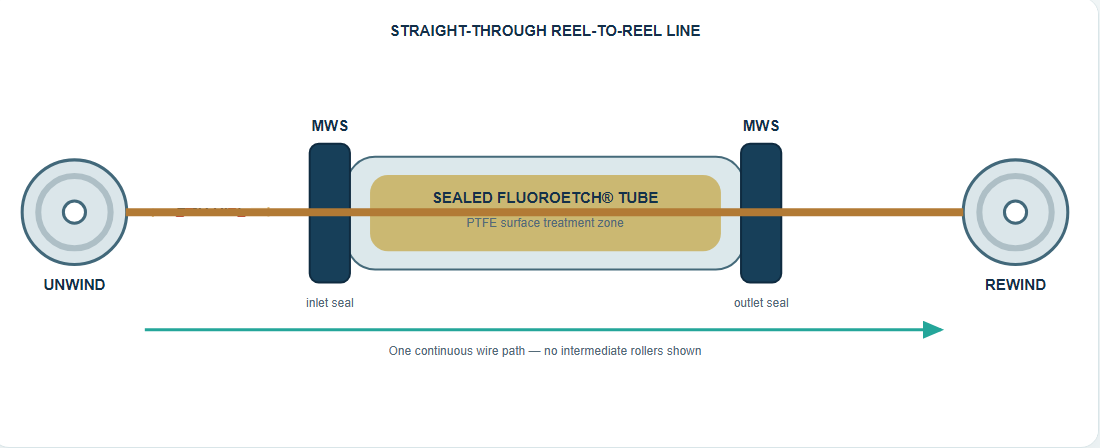
The wire follows a straight path through the process. The reel-to-reel overview appears first, followed by the simplified MWS tube arrangement. Printed process values are illustrative and are not validated settings for a particular wire or adhesive.
One MWS unit is installed at the tube inlet and another at the outlet. The wire passes continuously through both units and the sealed FluoroEtch® bath.
FluoroEtch® is a sodium-based fluoropolymer etchant. It modifies the outermost PTFE surface, making it more wettable and more receptive to many conventional adhesives. The process targets the PTFE insulation surface; the silver-plated copper conductor remains beneath the coating.
This application concerns PTFE-coated, silver-plated copper wire. MWS units form the moving-wire entry and exit interfaces at the treatment tube. Select and verify the seal material for the actual etchant exposure; the MWS units do not perform the surface chemistry or establish bond strength.
The page distinguishes the core MWS tube arrangement from optional preparation and rinse choices.
If the PTFE-coated wire is supplied clean and dry and is protected from contamination, cleaning and drying may be omitted. If needed, fully dry the wire before etching.
Pass the wire continuously through the sealed tube, with MWS units fitted at the input and output sides.
Use the hot, chlorine-free water rinse. The dilute acetic-acid rinse is optional and may be combined with Step 7 when the validated process calls for it.
Residence time depends on effective treatment path length and line speed. Establish temperature, speed, exposure, rinse, drying and acceptance limits by testing the exact PTFE wire construction with the intended bonding material.
The manufacturer of MWS units holds the following credentials:
IATF 16949 was formerly designated ISO/TS 16949.
FluoroEtch® process information is presented for general educational purposes. Follow the current supplier technical bulletin and safety data sheet and validate operating settings for the specific application.
Read the approved technical brief on the etchant, MWS sealing arrangement, and qualification of the tested MWS-003 EPDM compound for evaluated conditions.
Review MWS product options and ordering information for continuous wire applications.